Showing posts with label 1920's. Show all posts

Thursday, June 22, 2017

Metropolis

Metropolis


Dir. Fritz Lang

What an ambitious film! I'm going to go ahead and say that of the films I've watched so far for this project, this is easily my favorite to this point. There's so much of what I love going on here. Certainly this film is helped somewhat by the fact that I love science fiction, but even if that wasn't the case I still think there's a breadth of vision here that is so apparent as to be really something impressive. Honestly I'm not even sure what all there is to be said other than "go watch this film" but I'll try and give a bit of my thoughts as the story goes.

So the version that I'm watching is a restored edition that's around two and a half hours long. Apparently this is the most complete version of the film available, with five minutes of footage still lost to time. That said I'm impressed that they recovered thirty minutes of footage over the previous version of the film, and it's so much better for it I think.

The film opens with a wonderfully haunting sequence of hordes of workers marching in lockstep between their shifts. I'm immediately wanting to contrast this with Demille, who had his extras mostly acting as members of a crowd to look at the stars. Here though the extras have their own choreography and really become a big part of the visual language of this film, with their movements reiterating the machinery that they toil alongside.

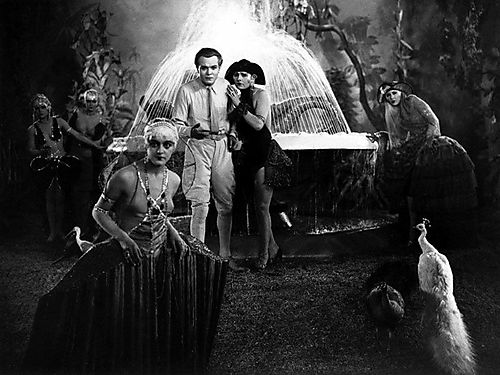
While the workers live a rough life, we meet one of our main characters, a wealthy young man named Freder Fredersen, idles away in a pleasure garden surrounded by birds and young women for him to flirt with.

Freder is eventually visited by a young woman named Maria, who is caring for a bunch of children from the working levels of the city. She introduces them to Freder, saying that they are his brothers and sisters. Fascinated, Freder follows them back to the working levels where he witnesses a giant machine that is under so much stress that it explodes, injuring/killing several workers. Freder then hallucinates that the machine is really Moloch, and that the workers march into his mouth to be consumed by the machine. It's probably the first sequence of the film where I was truly impressed. Especially for a film from 1927!

Freder, distraught by his vision, goes to visit his father to see if anything can be done to help the workers. His father, Joh Fredersen, is a cold man and also seems to be the person at the head of the city. He feels that the workers are in their rightful place dying to uphold the city, and when his son leaves upset by this, he hires a spy to go keep track of his son's whereabouts. There are a few figures in this movie which are really strange characters (one I'll get to later) but the spy is easily one of the stranger figures to show up. He's got this eyeshadow on that gives him a distinctly hawk-like appearance. Honestly, it's cartoonish in a way but it works within the expressionist style of the film where everything is sort of set in these mythical terms. Freder escapes to the lower levels of the city and trades places with a worker down there. Eventually, he's led to a secret meeting among the workers where the woman from earlier, Maria, preaches a message of hope to them regarding the Tower of Babel. The film cuts away to show this in wonderful detail, with droves upon droves of faceless workers trying to build the tower, only for it to come crashing down on the end, whereupon the workers attack the priests who had set them to laboring in the first place. Unfortunately, Joh Fredersen and a scientist named Rotwang who was in love with his late-wife (Freder's mother, Hel) are eavesdropping and decide that they need to find a way to ruin Maria's reputation among the workers. Rotwang is working on a synthetic human, and the two decide to kidnap Maria and have the machine-man disguised as her to break the trust of the workers.
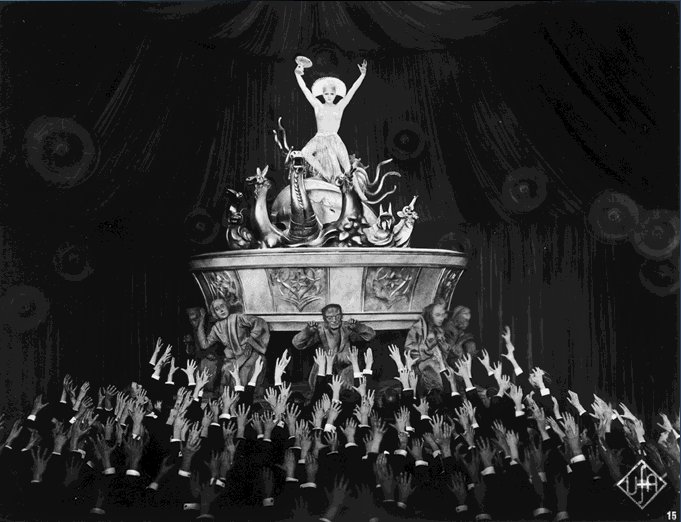
Freder declares his love for Maria, which she seems to reciprocate, only to be kidnapped shortly thereafter by Rotwang, who sets his plan into motion disguising the machine-man as Maria, and setting it loose upon the city to stir up chaos. Freder, who had seen the machine already attempting to seduce his father, falls into a delirium in which he has visions of the machine doing this really bombastic dance set to the dies irae and dressed up as the Whore of Babylon, sitting atop an urn made to look like the Beast and upheld by statues representing the seven deadly sins, presided over by death... I really have to wonder what the reactions were like for the prop and set designers of this movie when they were asked to come up with these elaborate constructions.

These visions do not seem to actually be happening. That said, the plan that Joh and Rotwang have cooked up does not seem to be working. While Maria had always advocated for a mediator to emerge between the workers and the rich industrialists, Machine Maria advocates that the two groups come to open conflict with one another. Riling the workers up, she has them launch a full attack against the heart machine, the machine that maintains all of Metropolis's basic functions. As the workers tear the machine down, the streets of the city begin to flood. The real Maria, who has escaped from her captivity, begins to help children escape while the workers turn against the Machine Maria, burning her upon a pyre of fallen metal, revealing her to be a machine all along. Surprised, the workers seem to calm down a bit as the real Maria steps up again and proposes that Freder, who's been running around this whole time just trying to point out that this Maria is fake, is claimed to be the prophesied mediator between hand (the workers) and head (the industrialists).

So disagreements about class and gender aside, I still think this film is a wonderful achievement. The blending of religious, sci-fi, and expressionist imagery really lends the film an identity all its own that I think is most closely echoed in Brazil by Terry Gilliam. There are so many other little details in this movie that my recap is leaving out, but I think in terms of just a huge achievement of filmic technique, Metropolis stands head and shoulders above its contemporaries.

Sunday, June 18, 2017

The King of Kings (1927)

The King of Kings (1927)


dir. by Cecil B. Demille

So I've never seen a Cecil Demille film before this. I knew that he was one of the heavy-hitters of 20th century film, specifically with his work on epic films like The Ten Commandments but I don't know that I'd ever actually seen an epic film either. If King of Kings is any indication of what they're like, I think they can be interesting films, though not necessarily my cup of tea.

King of Kings basically tells the story of the last weeks of Jesus's life--the passover entry to Jerusalem, the last supper, the trial and crucifixion, and the resurrection--because of the nature of the plot I'm not really going to go over whether or not I was surprised by the events of the story. I think Demille probably expected his audience to know the story going in and was more using this as a technical achievement for scale of a work than for any real innovation to the Christ tale.

So how are the technical achievements? Well they remind me a lot of Georges Méliès actually. There are lots of people on camera during shots all just sort of milling about, although where in Méliès it could sometimes be difficult to know where the focus of the shot was supposed to be, it's always pretty obvious in Demille, with the shots usually focused around a central structure (either architectural or a person standing amidst a crowd) and the extras sort of radiate out from there. Additionally, it was interesting to see the film use color. First time I've seen it during this project and while it's only there for the opening scene and the scene of the resurrection near the end, it's done pretty well.

That said, there's a very "of its time"ness about this movie. I didn't really see anything patently offensive around (though I may be overlooking something) but the new testament as presented in this film is very much the one that I think a lot of folks nowadays inherited from their grandparents. It shows a Jesus who is infallible, confident in his actions, and pretty much has this whole "being god's son" thing figured out. He kind of goes through the motions, really, and it is always clear to the audience that he's the one in the right being set upon by the droves of old-time Israel. I've not seen this other film, but from what I understand The Last Temptation of Christ is sort of the go-to example for a more modern interpretation of Jesus, and while it's tempting to just think of the portrayal in King of Kings as a relic, it's still a distressingly pervasive one, at least in the southeastern US where I'm originally from. There's no choice here, it's portrayed as so patently obvious that Jesus is in the right that anyone who chooses not to opt into this belief system is given a sort of villainous paint-job that removes all nuance from the situation.

Some other examples of this? Dear word, why didn't the other apostles throw out Judas Iscariot from the get-go? He's always scowling and looking like he's taking no joy in anything. Raising the dead? Bah! That's boring! Where's my gold? 


Like, I know he's supposed to be the traitor, but it seems more like that role has determined everything else about the character, rather than the character growing into that role. Again, this is probably unfair to the film, which is clearly more classical than modernist in its presentation, but it just seems like aside from the technical achievements, that this film was aiming for an older audience even at the time of its release.

There's some impressive stuff here--the sets are well-designed, the music is pretty good and the large crowd scenes are very well-done, but at 2 and a half hours runtime (seriously, there are some scenes here that go on about as long as scenes in 2001: A Space Odyssey), I'm not exactly chomping at the bit for the next Cecil Demille piece I'm going to be watching, which will be The Greatest Show on Earth.

Friday, June 9, 2017

Master of the House (Du skal aere din hustru)

Master of the House


dir. Carl Theodor Dreyer

TW: discussion of domestic abuse, sexism

So this is going to be, as ever, kind of a different commentary. I'm not so much interested in attaining a consistent formula to these reviews of movies, though. A lot of times they are meant as sounding boards of my recent thoughts and ways for me to air out my thoughts on different topics which I see crystallized in film. In this case, I'm going to talk somewhat about internet sexism today, but I want to use the movie as a way to frame that.

Now about the film itself; I've never seen a Carl Theodor Dreyer movie, although I hear he is considered one of those all-time great directors alongside folks like Tarkovsky or Bergman or Rosellini or Godard. I recognize that those folks all came along in drastically different contexts and their movies probably shouldn't be so flippantly compared, but for now it's just a point of saying that Dreyer is considered one of the greats--which is why this film is a bit odd. From what I understand, Dreyer's work is largely concerned with the numinous, the religious, the ecstatic; none of which are present in this film. I hear this film's one of those works included in the Criterion Collection more out of a way to trace a director's history than anything else, and maybe that's something to do with it. I do not mean that to sound as diminishing as it does, but Master of the House just hits that key for me where I can see some of the story work being done but it just falls flat for me in some ways.

The plot goes like this: Ida Frandsen (Astrid Holm) is an entirely too beleaguered housewife whose husband, Viktor (Johannes Meyer) has recently lost his job "turning him into" an abusive shithead. Seriously, this guy is just relentless and I might move past it if not for the fact that it's the central conflict of the movie. Viktor is just the most constantly demanding, belittling, and denigrating piece of shit I've seen. He complains about every minor inconvenience in his morning routine, and when Ida sets about fixing one thing, he complains that she is not fixing something else. He has the audacity to ask her what she does all day right before it's made clear to the audience that Viktor has no job, prompting the obvious question for me: "What do you do, ass?" The first half-hour or so of this movie is just a constant barrage of Viktor's abuses, only eased up in the reproachful glares given off by the character of "Mads" (Mathilde Nielsen), an old nanny who used to be Viktor's nanny as well, but now primarily helps Ida with the children and attempts to condemn Viktor for his treatment of his family. This portion of the movie ends when Ida, frazzled to the point of nervous collapse, decides to retire to her parent's home after Viktor places one too many absurd demands upon her. Mads assures Ida that, given some time alone with Viktor, Mads will be able to set him to rights, stirring up the old fear of her that she knows Viktor developed in his childhood.

So it goes then, that Ida leaves the house and leaves Mads alone with Viktor and the children. At once I do kind of worry that the children are subjected to more of Viktor, who, while most of his abuse was directed at Ida, was not exactly anything close to a decent parent either. However, with a variety of cutting words and sharp observations about his character, Mads is able to bring Viktor around and reform him, making him do most of the chores which he had previously demanded that Ida attend to. By the end of the movie, Viktor is changed, Ida returns home, and they are presented a check by Ida's parents with the hopes that they will use it to buy an optometrist's shop and move on. The End.

But wow, do I hate Viktor.

It's not like the movie is unsubtle about who's the villain here. Viktor is flatly awful at the start of this movie and I don't know why the characters need to suffer so that he can have his transformation and become the good guy that he was all along. It's like an ugly duckling story in which the duckling needs to make everyone around it suffer in order to learn that it was beautiful all along. Thing is, this isn't exactly uncommon even in media today. Guys are given much more of a pass (in western media, at least) when it comes to the assumption that there's some hidden good within them; or that their awful behavior is a result of having fallen on hard times.

I guess this strikes me particularly within this movie because much of the domestic life portrayed seems similar to the one some online neoreactionaries advocate for in their own politics and commentaries. Ida, Mads, and the daughters stay inside and tend to the home while Frederik, the young son of the couple, is allowed to play outside and Viktor spends his days doing who knows what. This plays out only for Viktor to come home and complain about the unpaid labor being performed for his benefit in the home. It's gross to see the narrative play out almost entirely for Viktor's benefit--he is "degraded" through his treatment by Mads, yes--but it's all for his benefit, and the narrative forgives him at the end. It's kind of similar to The Phantom Carriage really.

At the same time, I do wonder about the time period involved here. On the one hand, while Viktor's absurd treatment of Ida is viewed as something which can be reformed, at least it is viewed as something bad by the narrative, which contradicts a lot of that bullshit "every man a king in his castle" crap that MRA's spew. Similarly, while there is a bit of a "wacky hijinks" vibe that shows up when it's revealed that the central plot will revolve around Mads's correction of Viktor, she does not spare him any feelings and does bring him down from his tyrant status pretty much on her own, which could be seen as a major role for a woman to play in a film. I know that European culture has pretty much always been patriarchal, but I don't know to what extent early feminist thought had begun to appear in Denmark by this time. I guess it's really a matter of judging how much of an exaggeration Viktor's early behavior is supposed to be. If it's not that far off of the mark, this is at once a sad but perhaps more politically relevant film for its time. If it is a parody, then there is still value in its proclamation that this sort of behavior is wrong, but a bit dampened by the portrayal of it as parody.

Sunday, June 4, 2017

The Freshman

The Freshman


dir. by Fred Newmeyer and Sam Taylor

Overall: Well, this was sweet.

So given that this film was done by the same creative team as Safety Last!, I think it's a little bit obvious to compare the two. The two films, despite sharing the same directors and the same lead actor are very different in their tone and approach to comedy. Safety Last! feels more like it comes out of the Chaplin school of slapstick comedy, whereas this seems much more within the framework of standard trope comedy. The plot is very much a "young student wants to become the popular person on campus" story. I imagine it may've actually launched a number of these tropes which still crop up in American pop culture today.

Harold Lloyd again plays a young man named Harold, this time an aspiring young student who wants to become a popular student at the fictional Tate University. He's planning to model himself after one of his favorite movies, "The College Hero," and begins preparing his shtick, including dancing a jig before he introduces himself to everyone and coming up with the nickname "Speedy." It's really kind of awkward humor, which I usually don't like, but I guess the fact that the movie knows it's awkward humor and it's so far removed by time that I don't have much problem with it.

As was also the case in Safety Last!, this creative team has a really colorful way of giving a characterization by presenting anecdotes about the characters who show up. Tate University is described as "a football stadium with a college attached" which... wow if that's not still the case in a lot of places. There's also the football coach, who is "so manly he shaves with a blowtorch" and the dean who is so prim that "never married because he was afraid a wife might call him by his first name." Harold accidentally slapsticks his way into being on bad terms with the dean, and is unknowingly made the butt of a joke by an older student who continuously sets him into situations that make him appear foolish. Eventually, Harold develops something of a reputation as a clown in the school.

The only person who's not boarding that train is Peggy, a young woman who Harold met on the train to Tate and who turns out to be the daughter of his landlady. Peggy tries to tell off Harold's bullies, and several times comes close to telling Harold that his "friends" just see him as the butt of a joke, but she can never bring herself to do it because he just seems so darn happy. Eventually, Harold finds out about this and is dejected, but determines to win the student body over by playing a role in The Big Game against Tate's rival university.

I feel like the plot of The Freshman is a bit of a formality in retrospect. It almost certainly cemented a number of these tropes in the pop cultural consciousness but that's just the issue! These tropes are so embedded that going back it's kind of easy to predict where a scene will go. That isn't to say it's not fun. I don't need things to be new or innovative all the time, but there's a certain desire to just ignore the plot in describing this. Yeah, Harold Lloyd's acting is great (honestly the best parallel I can think of is probably Mickey Mouse from some of the early Disney cartoons. There's an earnestness to the character that carries them through the various scrapes they find themselves a part of. However, Harold's also got a bit of a Daffy Duck component to him where it's notable that he only ever barely scrapes by).

Even still, fun movie and I'm glad it didn't have any of the weird racial components that were there in Safety Last! The Freshman is a fun movie overall and worth the watch.

Sunday, May 21, 2017

Body and Soul

Body and Soul
directed by Oscar Micheaux

Overall: Ugh... let me try to break this down into parts

oh and spoiler warning for the movie Brazil, not gonna rot13 because I'm too pissed off..

TW: rape, abuse by an authority figure, some talk of race.

THE GOOD:
  • This movie is one of Oscar Micheaux's "race movies." Movies that were directed usually with all black casts and made for black audiences. Back in the 1920s these films were very controversial and in the case of Body and Soul, there was trouble screening them. The original director's cut of Body and Soul has been lost to time so it's an impressive act of film preservation to cobble together a cut of the film at all.
  • The new jazz score by Wycliffe Gordon is awesome. Seriously, I'd play this movie again just to have the score as background music for whatever I was doing.
  • This was the first film that Paul Robeson starred in. Just for the record - I don't blame Paul Robeson for the bungle of a plot that's in this movie.
  • Even though the film is largely remembered for Paul Robeson, the protagonists of the film are actually two black women, which I imagine was exceedingly rare at the time (hell, it's rare now).
THE BAD:
  • I'll get to my major complaints, but a minor one first: Paul Robeson plays two characters in this film: The crooked reverend Isaiah Jenkins (AKA, the criminal "Black Carl") and his twin brother Sylvester, who is barely in the film. Honestly it's kind of confusing to keep track of why they even had the two as brothers considering it really doesn't come up. It just seems like needless recasting.
  • This may be the first movie in the Criterion Collection that I've come away from disliking the plot of the film. I mean, don't get me wrong - The Phantom Carriage had a messed up "forgiveness" creed to it too, but at least there the film didn't linger so long on it as to really annoy me. Here though... well I'll just give a rundown
  • So the plot centers around the arrival of escaped prisoner Black Carl, who is passing himself off as the Rt. Reverend Isaiah Jenkins and hopes to scam a small black community out of their money. The members of this community tend to fall for Carl's ruse except for a young woman named Isabelle. Isabelle, who is hoping to marry a young inventor named Sylvester (also played by Robeson), is openly suspicious/contemptuous of the reverend, but her mother Martha Jane just believes that Isabelle is being sinful, and hopes to make a match for Isabelle with Jenkins. Jenkins pays a visit one day at Martha Jane's behest, and it's heavily implied that he rapes Isabelle while Martha Jane is out. Isabelle runs away to Atlanta, leaving a note behind where her mother's funds were hidden away telling her mother of what she's done.
    Martha Jane soon takes off for Atlanta and manages to locate Isabelle, who is on her deathbed. Isabelle tells Martha Jane the truth - that she had been raped once before by Jenkins and that when he came around to the house earlier in the film, he had Isabelle tell him where the money was hidden under threat of raping her again. She gave him the money and then ran away, knowing that her mother would not believe her.
    Isabelle dies and Martha Jane returns to her town where she confronts and exposes Jenkins in front of the congregation. The people form an angry mob and begin hunting Jenkins down while Martha Jane returns to her home. While on the run, Jenkins turns up at Martha Jane's house and has the audacity to beg forgiveness of her - and she forgives him.... Following this, Jenkins leaves and appears to escape? He seems to kill one of his pursuers and disappears off into the distance, at least. Then we return to Martha Jane, and she hears a knock at the door.
    It's Isabelle... and Sylvester... and the money's back.... and it was all a dream.
    I'm serious.
    The film ends after Sylvester and Isabelle have married. They return home from their honeymoon and happily play the piano with Martha Jane.
  • Woof
  • Just woof
  • Like, how do you even begin with this thing? If you try to untangle one knot, two more show up.
  • For starters - using rape as a dramatic center of a character's journey... even if it isn't one's own, is an unfortunately common trope in storytelling - I don't mean to say here that it should be downplayed when it does happen (although sometimes I think the question of necessity does arise), but only that it's too often used as a motivating factor for action in storytelling.. I've got a few other films/stories down the line that'll probably be more fertile ground for exploring this topic, but for now I just want to register my distaste.
  • And then! And then it's all a dream in the end? Okay so I thought of a few things when I saw this - 1) I think one of the only stories that gets to have the "It was all a dream" bit tacked on is Alice's Adventures in Wonderland. Here it seems to undermine all of the drama of the film and even seems to make the earlier abuse of Isabelle into just a plot device!
  • Alternatively, the ending may be like the ending to Brazil, where Martha Jane's gone into a sort of catatonic reverie. Honestly, I could buy that possibility, but there's no hint of it given in the film other than just how bizarre the ending is in general. But jeez this would be an absolutely Kubrickian film if the ending is that bleak.
THE UGLY:
  • Okay, so the concept of forgiveness that shows up in this film is an odd one. I remember a couple of years ago I listened to an episode of the podcast This Week in Blackness Prime, a news and culture podcast hosted by Elon James-White, Imani Gandy and (at the time) Aaron Rand-Freeman, in which Elon's mother, a devout Christian, addressed the concept of forgiveness as it applied to her own abusive stepmother. She seemed to imply that in the context of Christianity (and perhaps black American Christianity more specifically) forgiveness acts as a kind of way to not let the perpetrator of a crime have power over the victim, with the expectation being that justice will be meted out in some other fashion. From what I've gathered after talking to a few people, this is supposed to be something of an empowering act on the part of the wronged. I wonder if there's a reading of this film that reads Martha Jane's actions as good in this regard. I'm conflicted, of course, because it seems to ignore Isabelle's wishes, but then again Isabelle is dead at this point. It just seems like a messy component that's wrapped up in cultural idioms I am not really that well-versed in, so if anyone has any sort of commentary or insight into this they'd like to put out there for the purpose of understanding, feel free.
Final note: If you've experienced abuse at the hands of a religious figure (and you're in America, I guess) the National Domestic Violence Hotline can help you locate resources in order to get you help within your local area: their number is 1-800-799-7233.

Tuesday, May 16, 2017

Safety Last!

Safety Last!
directed by Fred Newmeyer and Sam Taylor

Well this one's a little bit less thought-provoking than Nanook or Haxan. Still though, it's an interesting and at-times pretty serviceable comedy picture.

Harold Lloyd stars as a young man named Harold (called "The Boy" in the credits) who is set on making it big in the city. He leaves his family in the country and tells his fiancee that once he's made enough money they'll buy a house and get married. Unfortunately, his job does not pay as well as he'd like and he's having to pawn off his possessions and avoid paying rent in order to keep up the appearance that he is making money.... which, I mean, could just be avoided by being honest but whatever.

This early portion of the movie is probably the part that I find the funniest. It's mostly filled with slapstick as Lloyd attempts to go through his work day and must be quick-witted in order to avoid the ire of his managers. It's really reminiscent of Chaplin. However, while Chaplin seemed to almost stumble into and away from his problems, Lloyd has a little bit more thought given over to them. His ideas come across like schemes, and the humor comes from misdirection in that oftentimes the schemes appear to fail, only for Lloyd to quickly adapt and change the means by which he accomplishes his task.

After this opening bit of to-do with the daily grind, though, the movie begins to take a little bit of a downturn for me. Maybe this is just a personal thing, but I tend to dislike scenes in movies where a character has to maintain a charade, pretending to be someone they are not in order to keep another character in the dark about something. Particularly when it's a situation like this - Lloyd's fiancee comes to visit him in the city and Lloyd, afraid to have her figure out that he is only a salesman and not a manager or anything, contrives various ways to fool her into believing he is much higher on the organizational chain than he is. The whole thing reeks of class prejudice and although there's some cleverness in the way that the scene escalates, it's just not really my kind of thing in terms of comedy.

The final sequence of the movie though, and probably the most iconic, is really interesting. In order to try and make some money quickly, Lloyd proposes to his manager that he can pull in one hundred customers by staging a public stunt in which his friend/roommate Bill will climb the department store building to the roof - twelve floors. Bill is confident that he can do this, as he's demonstrated that he's pretty good at climbing buildings earlier in the film when he does this in order to escape a police officer who he and Lloyd prank. On the day of the event, however, the police officer is present and hopes to catch Bill, meaning that Harold has to take Bill's place. The plan is made that Harold will climb up a floor, go into a window and switch outfits with Bill. Bill will then climb the rest of the way up. This goes awry, however, when the police officer notices and starts chasing after Bill, meaning that with each floor Harold attempts to make the switch but can't, pressing him to climb further. I'm sure that one could look at this as some kind of hopeful symbol for American can-do-itiveness, but for me it reads more as really nice suspense... also it reminded me a lot of Bob's Burgers for some reason (Harold = Bob, Bill = Teddy). While each floor of the building becomes more difficult, with several close scrapes with death occurring, Harold eventually makes it to the top of the building where his fiancee has arrived. It's never made clear whether or not Harold comes clean, as the two walk off into the sunset, and Bill is pursued across rooftops by the officer.

While I wasn't exactly as big a fan of this movie as I was The Kid, I can see that in some ways the films are coming from different ideas about comedy. This film is very much about the misdirect, while I'd say that The Kid is more pure slapstick comedy. There are more films with both Lloyd and Chaplin on the list, though, and I look forward to seeing more.

A few other notes:

-There's a little bit of discomfort with some portrayals of racial and religious minorities in the film. While all are minor, and the two black characters don't stick around very long, there's a jeweler who I think is supposed to be Jewish, and is played in a very stereotypical, hand-wringy, greedy fashion.
-Harold's snobbish superior, the floorwalker Stubbs, is a great addition. He's all the right kinds of nose-in-the-air self-satisfied villain that works well in comedy movies featuring class dissatisfaction.
-The city in the film is Los Angeles, and Harold and Bill are able to rent an apartment there for 14 dollars a month. Converted to 2017 spending power, that's somewhere between 180 and 200 dollars a month.

Tuesday, May 9, 2017

Nanook of the North

TW: Discussion of racist/stereotypical presentations

Overall: How do you talk about a film like this?

I've head the name "Nanook of the North" since childhood. Usually some character in a work would be jokingly nicknamed Nanook and I learned that it was some reference to an old movie. The only reference I came across in recent years was from the Legend of Korra, in the form of "The Adventures of Nuktuk: Hero of the South". Where LoK sort of pokes fun at the film, I think it might actually be a good reference for me to check back with in addressing the film's interplay between Flaherty (the director) and Allakariallak (The Inuk star of the film, whose character is named Nanook).

That's a starting point right there, of course - the fact that the film is presented as a documentary is in many ways laughable. The character of Nanook is not real. He is an amalgamation of various Inuit half-truths presented in a manner similar to how some members of the Maasai partake in tourist attractions today. In the 1920's when Nanook was filmed, the Inuit were using rifles and had begun integrating western clothes into their lives. Allakariallak knew what a gramophone was, and didn't need to be told. However, therein lies the rub, I think. Nanook isn't Allakariallak, and this film, though it purports a documentarian stance, is mostly a fictionalized account of a fictional person's life.

There are tons of ethics questions to unpack here. On the one hand, indigenous peoples being presented as ignorant of western society is damaging and a real ugly way to go about making a film. On the other hand, I have to remember that Allakariallak was a star. As far as I know, he and the other people in the film were not forced to do any of the things their characters did - they were cast and paid actors who at the very least were actually Inuit people and not white folks in facepaint.

The film's narrative is almost entirely fabrication - Allakariallak did not die of starvation while hunting two years after production, as the film suggests--he died of natural causes in his home. The igloo that is built was not used for filming interior shots, as the camera could not fit inside. There are rumors that the scene in which Allakariallak wrestles a seal on the other end of a rope actually had no seal on the other end. The film is not a documentary in any "let the cameras roll" sense. It's an ethnographic film, that like an ethnography, purports to make claims about a population based on some minor observation and storytelling techniques. I'd really be interested in hearing various perspectives on this film, as I imagine there are plenty. I think for me the most troubling aspects of the film are the use of the term "e*****" to refer to these people, and the killing of various live animals that took place as a part of the filming. I generally don't like when live animals are used for film narrative purposes, and especially not when they're hunted as a "documentarian" venture. In terms of representation, though, I don't know that it's the worst representation I've seen. It's got its problems, but there is a measure of reassurance in the casting of actual Inuk people.

I realize as I write this that there's not much I can say by way of the film's "plot." It mostly follows the character of Nanook in the daily life of his family. They go about trading, hunting, building an igloo, and trying to survive. There is no real antagonist, except perhaps the elements, and the film doesn't really have a climax as much as it does a final scene in which Nanook's dogs begin fighting one another (ugh) and Nanook settles it down. His family is then unable to start building an igloo because it is too late, but they find an abandoned one to bunker down in for the night.

So I think for documentaries I'm mostly just going to do commentary and avoid plot synopses as I make my way through these collections... so then, like I said at the beginning, let's talk about Korra.

In The Legend of Korra, there's a sub-plot that crops up throughout seasons 2 and 3 surrounding the character of Bolin who becomes a "mover" star in a serial called "The Adventures of Nuktuk: Hero of the South" and while it's obviously a play on Nanook I can't help but draw some wider parallels between the production of Nanook and the production of The Legend of Korra.

Nanook is fake. Allakariallak was a movie star who played a character named Nanook. In the same way, Nuktuk is fake, played by a mover star named Bolin. But let's abstract this a bit further. Bolin is fake. P.J. Byrne is an actor who was cast in the role of an asian-coded character by two white directors. These two directors take potshots at the idea of appropriation and anachronism that plays into the making of the Nuktuk serials, while themselves creating a story which loosely plays on folklore and various non-white cultures as viewed through a white western lens. I mean, even the voice acting, although including some notable names (including Jason Isaacs as Zhao) is largely absent of people of color, especially when compared to another animated property that came out half a decade earlier and featured a non-white cast of characters, Disney's Mulan.

What am I trying to get at here? I'm not exactly sure, I guess. I suppose that if I have a point it's that I'd be hesitant to go after Nanook of the North as an antiquated, harmful, and racist piece. I mean, certainly these things are in it, don't get me wrong, the fact that they use the word "e*****" is point enough, but I don't really think that it's fair for modern audiences to posture as though our own media properties have undergone some great leap forward with regard to how non-white actors are cast and live action people of color are presented on film.

I'd be perfectly willing to hear other perspectives with regard to this topic, but I'm hesitant of inviting some kind of flame war... I may very well be overlooking some crucial analyses that have been done on Nanook over the years that could shed some new light on the topic, this was just sort of where my mind went upon viewing it. A film which seems to say more about the filmmakers and what they consider uncivilized (albeit admirable in some way). Which, ironically, is set against films like Haxan and what 1920s culture considered civilization.

Monday, December 19, 2016

The Kid

The Kid
Directed by Charlie Chaplin


TW: Parental abandonment

Comedy is a hard thing to do. Over time I've become more and more reserved in my comedic senses and don't typically enjoy the genre. My favorite comedy movie is probably The Big Lebowski, which I enjoy primarily due to the very well-written dialogue-based comedy which builds over the course of the film. As far as other comedy goes, I enjoy It's Always Sunny in Philadelphia, Community and Tim and Eric but beyond these I tend to find a lot of comedy pretty hackneyed and reliant on a shared sense of humor. If the sense of humor isn't shared between writer and audience, the comedy can fall flat.

It's nice, then, that The Kid has held up so well over time. It's actually a pretty impressive movie in its own right, with lots of wonderful choreography and impressive shots, but I want to highlight that the movie is one of the few I've found funny in years. Chaplin and Coogan play well off of one another and so many of the scenes are brilliantly choreographed. In my opinion, slapstick is like a dance, and to do slapstick well requires a lot of precision in making things look like accidents.

The plot of the movie is okay for what it is. An unnamed woman gives birth to a child, and due to complications with the father, decides to abandon the child in the back seat of an expensive car, leaving a note asking whoever finds the child to take care of it. The car is stolen and the thieves, upon discovering the child, leave him on the street where he is found by Chaplin's 'tramp'. The tramp takes the child in and becomes a father to the child, who eventually becomes a player in the tramp's con-artist game.

The woman, now distraught over her child and wealthy, takes to charity work among the poor, where she comes across her child (now named 'John'), but the two do not recognize one another. When John becomes sick one day, the woman offers to call a doctor. The doctor, upon finding out that the child is not the tramp's biological son, calls an "orphan asylum" to take the child away. Hijinks ensue and the tramp and John are left wandering the streets, avoiding the authorities. Eventually, the child is given over to the police (kidnapped, actually) and the woman arrives to take him back.

The Tramp, now tired after having searched for John all night following his kidnapping, falls asleep on his doorstep and has a pretty bizarre dream sequence where various characters in the movie are now angels. The Tramp becomes an angel too and all seems good until three devils sneak into the gated neighborhood where the angels are living. Things go downhill from here until The Tramp is shot and wakes up to find that he's being hoisted up by a police officer. The officer takes him to see the woman and the child, who welcome him inside the woman's mansion gladly.

So I don't really want to talk about the plot to this one. I have some pretty conflicted feelings about how the child's custody is handled throughout the film. Maybe I'm being too harsh here, but it seems to me that the woman is thoroughly in the wrong for having abandoned her child. Not necessarily for the decision to not take care of a child herself (plenty of circumstances arise that make child raising by a particular parent a bad decision for all parties) but in her method of trying to find an adoptive parent by literally leaving the child in the backseat of a car with a note. I understand she was trying to put the child to a well-off family, but it's still reckless endangerment.

But like I said, I'm more interested in talking about the comedy; or the dramedy more accurately. I'm amazed at how much this film conveys through visuals alone. One of the things I think people oftentimes forget about silent films is that not all dialogue needs to be given an intertitle. So much of the dialogue can be inferred or left to the imagination of the viewer and, far from something being lost, I think a lot is added to a film as a result.

I'm actually really pleased that I found this film. I remember watching Modern Times back in undergraduate, and I thought it was okay. Now, having seen this, I'm really looking forward to checking out the Harold Lloyd and Chaplin films that are also on my list.

Sunday, December 18, 2016

The Phantom Carriage (Körkarlen)

The Phantom Carriage
Directed by Victor Sjöström


TW: Talk of abuse, alcoholism, suicide, illness, death

You're a complicated man, David Holm.

It's New Years Eve, and two people lay dying, one will become this year's carriage driver, the other will be taken away.

This is the interesting mythology set up in the beginning of The Phantom Carriage. The last person to die before midnight of the new year must become the driver of the titular phantom carriage, performing a grim reaper role for the following year until a new person takes their role at the end. While time zones obviously present a complication to this, we're very much working in the world of folklore on this one, and while the film begins with some interesting shots of the carriage driving around the countryside, picking up accident victims, the carriage is actually fairly incidental to the plot.

The plot instead revolves around the two dying people. One of them, Sister Edit, is concerned for the welfare of the other, a man by the name of David Holm. After sending a colleague and friend to go asking around for him, she goes back to resting in anticipation of her death.

David Holm, for his part, is not exactly a well-off sort. Sister Edit's colleague finds Holm drunk with two friends in a cemetery. After telling Holm the situation, he refuses to come see Edit. Afterward, Holm's two fellow homeless friends begin to berate him for his choice. A fight breaks out and Holm is killed in the struggle.

Now here's where the movie kind of changes gears, and where its classification as a horror movie (on wikipedia and other websites) comes into question a bit. When Holm dies, he's approached by the driver of the phantom carriage, Georges (a former companion of David's), who tells him the situation. Holm is the last one to have died in the year and so he'll be the new driver of the carriage. Holm is then guided through a reflection by Georges as he's asked to remember how his life has come to this point.


We're then given an extended flashback which makes up the bulk of the film. David Holm was once a family man with a wife and two children who he seemed to love very deeply. Between edits, we're informed that he was led astray to alcoholism by Georges. After falling unconscious in front of his house one evening, David Holm awakens in jail. The policeman here is really pretty ridiculous in terms of his talking to Holm. He informs David that his brother has committed murder and that somehow this is David's fault for the two of them drinking the night before.

Now if this is where the film stayed, I could see David Holm as a sympathetic figure; in a sort of "one bad choice" kind of way. However, this is based on the previous characterization of Holm as a pretty alright guy only recently convinced to start drinking by Georges. Instead, when David is let out of jail he returns to his apartment to find it empty, his wife, Anna, having left with the children to get away from him. So, what does he do?

He vows vengeance against them. It's such a drastic change in tone and it's like David Holm just dedicates himself to being the most awful person he can from there on out. He is driven into poverty over his country-wide search for Anna and one New Year's Eve, he arrives at a Salvation Army shelter that's just been opened by Sister Edit. Sister Edit is such a bundle of goodness, just happy to do her job for a person in need of help. She gladly lets David stay the night, taking his coat to mend overnight as he rests.


The next morning, David is awoken by another worker in the shelter and is given a breakfast and his newly mended coat. Impressed by the mending, he asks to meet Sister Edit. Upon her arrival, smiling and all anticipation, he rips the jacket apart in front of her, undoing all of her work just to be a jackass. Sister Edit, cinnamon roll that she is, asks him to please return in one year's time on the next New Year's Eve, as she had prayed that their first visitor would find good fortune over the next year. He agrees, seeming to relish the thought of breaking her faith.

Real pleasant guy.

Georges then tells David that he's going to make him fulfill his promise. After working some ghosty-magic, he binds David and takes him to Sister Edit's side. Edit cannot see David, but sees Georges, begging him not to take her before David comes to visit her. David seems to be distraught over her situation, and we're given another flashback.

Over the next year following David's original visit to the shelter, Sister Edit runs into David Holm a few times and despite the fact that she has now contracted tuberculosis from the bacteria on his coat, she is still insistent that he try to better himself. Holm, for his part, grows more and more monstrous as if to spite her. He shows up at a Salvation Army meeting and begins coughing on people, hoping to spread his sickness further.

Just as it happens, Anna is at that Salvation Army event, and approaches Sister Edit about David afterward. Edit is insistent that the two reconcile and manages to arrange a meeting between the two (would not have advised that at this point).

David and Anna reunite and David is surprisingly not a total dick about the situation. The two seem to reconcile and decide to give it another shot. However, we see that a few weeks later David's reverted to his old ways and is now even NOT CONCERNED ABOUT INFECTING HIS CHILDREN WITH TUBERCULOSIS. When Anna asks that he not, he coughs on them directly. Anna manages to lock him in the kitchen of their house as she tries to take the children and leave. David, realizing that he's locked in, reveals the fact that he was an inspiration for Stanley Kubrick's version of Jack Torrance and begins axing the door to pieces. Anna faints before she can get away with the children and David escapes and tries to get his wife awake.

We come back to Edit, who BLAMES HERSELF FOR DAVID'S DEEDS BECAUSE SHE BROUGHT THE COUPLE BACK TOGETHER. David manages to get Edit to see him, showing that he is moved by her admission of guilt and she dies in peace. Georges tells David that she won't be coming with, she'll have a different emissary coming for her, and he and David leave as they have one more errand that night before David is to take over the job.

They arrive at David's house, where he finds that his wife, afraid for their children's welfare due to the fact that she is also dying of consumption, is planning to poison both the children and herself. David, horrified by this, asks Georges to intervene, but Georges tells him that he has no control over the living. After pleading, David suddenly regains consciousness in the cemetery, running home to stop Anna from committing suicide. He arrives and manages to stop her, the two embrace as David mutters a prayer, promising to reform.

This film is complicated for me. On the one hand it is a beautiful film - wonderfully edited, orchestrated, and shot. The concept of the carriage itself is an interesting one, and Sister Edit is a bundle of goodness. But goddamn David Holm is just not a sympathetic character. He may've been at one point, but his actions across the course of the film paint him as a repulsive man who maliciously attempted to make everyone else's life as miserable as he could. I mean, I'm all for film's featuring bleak characters, but I'm a bit more conflicted about this film's presentation of Holm as a tragic character with hope for redemption at the end. While maybe he can reform, his actions seem to paint the picture of a really horrible person over the course of the film, and maybe the film is a bit more like Sister Edit in terms of its certainty that he can reform, but I'm a bit skeptical.

Häxan

Häxan
directed by Benjamin Christensen


TW: for discussion of oppression, historical torture (inquisitions mostly), religious abuse, and coerced psychiatry.

How do we take a movie like Häxan? In some ways I feel like watching this is akin to watching DW Griffith's Birth of a Nation. On one hand, it's a piece of filmic history, on the other it's a reiteration of what were (and are) systemic injustices and violences done upon various marginalized bodies (women in the former and black people in the latter).

I'll grant that Häxan is probably not as purposefully inflammatory as Griffith's film. It takes its subject, the history of witchcraft and the treatment of women accused as witches throughout history, as a symptom of a bygone superstitious belief system supplanted by scientific insight and more modern medicine.... but that's.. well we'll get there.

The film begins with a recounting of various myths from throughout history, landing on how the conception of medieval Christianity conceived of the world as existing in spheres, at the top of which sat the Christian God and at the bottom of which was found Hell.


From here, we're informed of the belief that throughout history certain women were perceived as being particularly susceptible to the influence of the devil. It's interesting that the movie's portrayal of this history is very much of a double consciousness about this. On the one hand, these women are to be pitied and helped (oh the help...), but this is most often when they are in the company of men. When these women congregate together, they are feared. There are some really stunning shots during this part of the movie as the film shows the witches in flight across various nighttime foreground structures.


From this somewhat empowering view of the witch as an object of fear, the movie then moves us forward to a period where religious persecution holds sway. In this segment of the movie, we see that the movie does at least know that the treatment of women at this time was vile. Women are pressured into confessions under threat to their loved ones, and are routinely killed after enduring horrible torture at the hands of these monks and inquisitors. It's really at times some pretty brutal stuff, and there's a real sense of the injustice of the time.

After wrapping this up, the film begins its conclusion that's a bit... well, it's cause for reflection. The film was made in 1922, and I imagine was one of the very early documentary style films. The film has a very "look how far we've come" attitude about the attitudes toward women. Saying that what used to be called witchcraft.... is now properly known as hysteria....

The funny thing is, I think the film's a bit of a mirror. So many people still berate feminists with this idea that because women are now able to do X action (vote, work, have birth control), that we've somehow totally overcome sexist ideology. In this way, Häxan seems less like an opportunity to shake our heads at the ignorance and misogyny of these people in 1922, and more as an invitation to look at how this same sort of pattern of thought is ongoing and insidious, and that changes to ideology (such as the introduction of intersectionality to feminism) are needed as a fine-tuning instrument, lest we claim some action or movement as a panacea for oppression (as psychiatry is posited in this film).

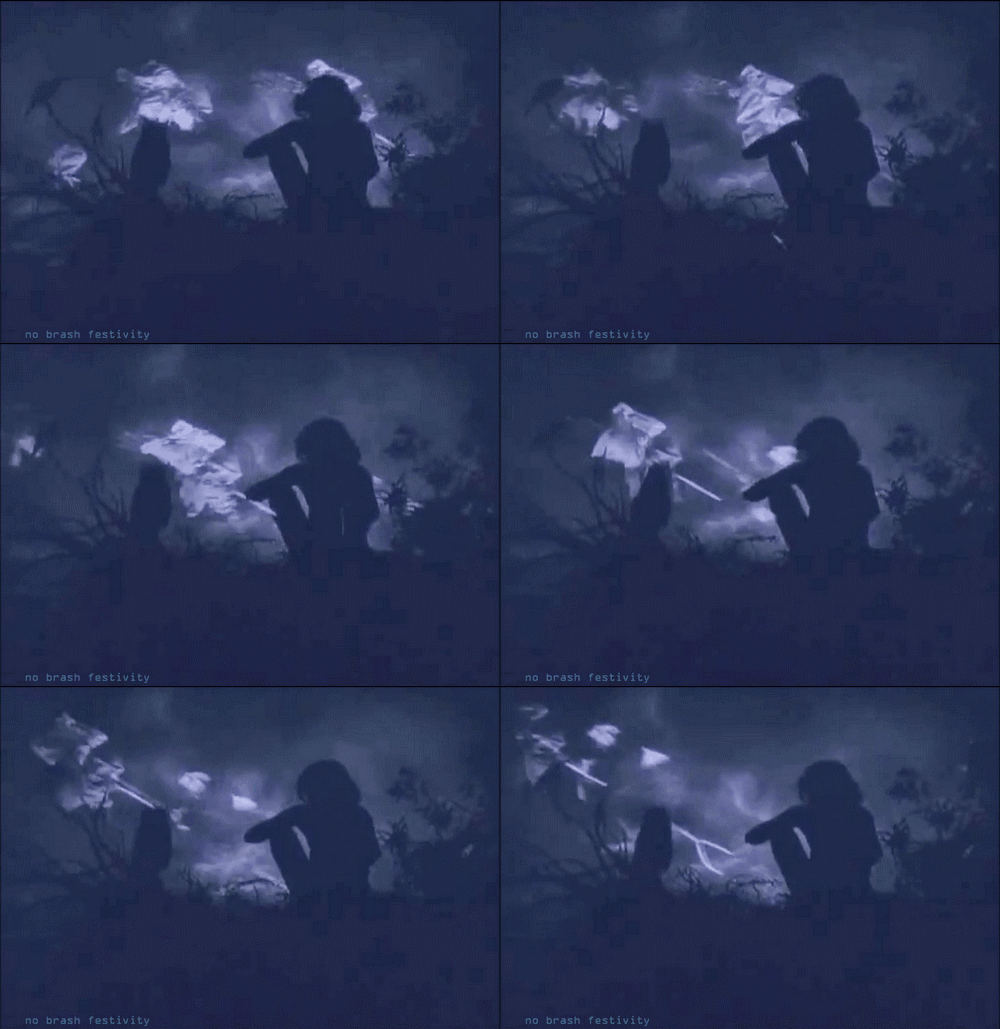
Given this, I also think that the sympathetic portrayal of the witch is interesting. I have several female-identifying friends who associate strongly with various forms of witchcraft, paganism, and Wicca. I think that in some ways these are oftentimes counter-narratives that go against the patriarchal narratives instituted by Western Abrahamic religious hegemony. It's a subversive tactic, and the shot that I'm reminded of the most comes from the end of the witch segment of the movie. In it, it's explained that it was believed that witches would turn into cats and, with animal guards, sneak into churches and crap on the floor. I can't help but see this as another instance of the film discussing a sort of subversive tactic taken against oppression.


Also it has these hilarious costumes of the people dressed up as cats.... like, they could've just used real cats. But no, they made like, four or five of these costumes.

Nosferatu, eine Symphonie des Grauens

Nosferatu, eine Symphonie des Grauens 
directed by F.W. Murnau


Okay so it's not a criterion film, but it's part of another film list I'm working through, the 366 weird movies list found on 366weirdmovies.com. Also I wanted to watch a movie for Halloween that I hadn't seen yet, so I figured this would be a good opportunity for it.

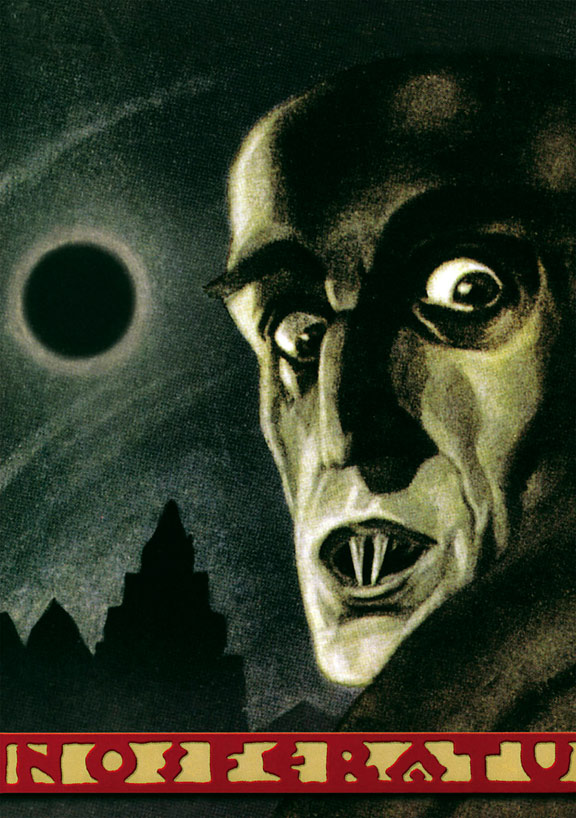
So, going in, I knew that Nosferatu featured a rather marked variation from the standard Holywood vampire. Even Lugosi played a more attractive vampire than Schreck's Orlok, who I always thought looked kind of silly and uncomfortable in his costume. Other than that, though, I only knew of the films legal troubles with the Stoker estate.

Overall, I think Nosferatu is an interesting yarn that really dwells in its atmosphere very well. From the moment the film introduces Hutter's (this film's Jonathan Harker) boss Knock, there's this off-kilter feeling. I remember back in undergrad I watched The Cabinet of Dr. Caligari for a Horror-film class that I was in, and I was struck by the highly expressionistic set design of the film. Although Nosferatu came out two years after Caligari, it has a markedly different visual language to it. This isn't a bad thing, although... well I'll get to this later.

The shots that this country gives of the European countryside are just absolutely gorgeous! Unfortunately I couldn't really find any to post here, but there are many shots of mountains, rivers, and fields that just give this stunning view of what're supposed to be the Carpathians I believe.

Once Hutter meets Orlok, I will say that the film differs in a number of ways from Stoker's novel. Where Dracula was charming and polite, Orlok almost immediately tries to drink Hutter's blood. Also, notably, the brides are absent from this film. This isn't really a problem, but it does make Hutter's need to "escape" the castle once Orlok has left a little less clear.

The film differs drastically from the book at the end. The character of Ellen, Hutter's wife, who is sort of a combination of both Lucy Westenra and Mina Harker, seems to know that she needs to sacrifice herself so that Orlok will die in the sunlight. I did initially wonder if there wasn't any other way, but I kind of knew her death was coming toward about the midway point in the movie. I will say, I did notice as the movie went on though that Ellen is really the protagonist of the film. Hutter sets up the initial interaction between Orlok that prompts him to come to Germany, but from there all of the conflict revolves around Ellen and her figuring out how to set up Orlok's death. I'm somewhat uncomfortable with the whole "women dying in horror movies" stock thing, but I guess I'm a little bit more okay with it when it's more of a sacrifice to kill the film's monster. What're other folks thoughts on this?

A few other observations, most of which are minor nitpicky things
-There's a point in the film where an innkeep warns Hutter of a werewolf that prowls at night, and we get a shot of this werewolf and... it's so clearly a Striped Hyena. It's also adorable.
-Orlok at one point carries his coffin through the German town he's bought a house in and it's hilarious to watch. He's sort of awkwardly holding it under his arms and walking like he's trying to sneak around with it. Also, it's very obviously daylight in these shots, and I think we're just supposed to pretend it isn't. Maybe this is one of those things that would've been less apparent on older film.